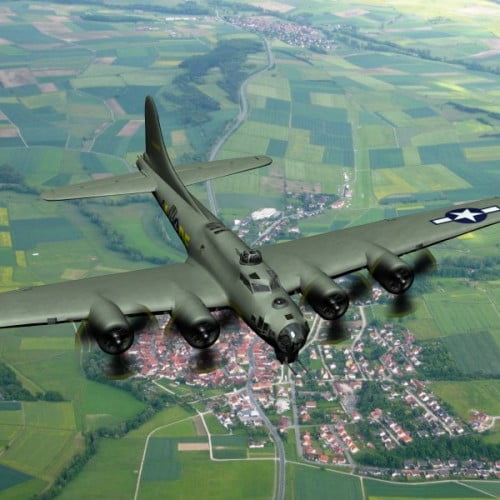
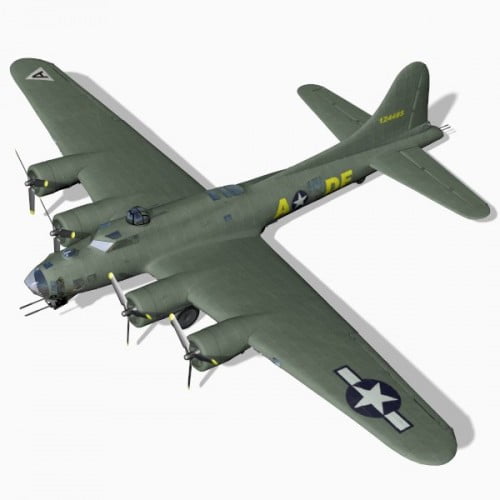
The B-17 Flying Fortress is a four-engine heavy bomber aircraft developed for the United States Army Air Corps (USAAC). The B-17 Flying Fortress went on to enter full-scale production and was considered the first truly mass-produced large aircraft, eventually evolving through numerous design advancements.
The B-17 was primarily employed by the United States Army Air Force (USAAF) in the daylight precision strategic bombing campaign of World War II against German industrial, civilian and military targets. The United States Eighth Air Force based in England and the Fifteenth Air Force based in Italy complemented the RAF Bomber Command's nighttime area bombing in Operation Pointblank, to help secure air superiority over the cities, factories and battlefields of Western Europe in preparation for Operation Overlord. The B-17 also participated, to a lesser extent, in the War in the Pacific, where it conducted raids against Japanese shipping.
From its pre-war inception, the USAAC (later USAAF) touted the aircraft as a strategic weapon; it was a potent, high-flying, long-ranging bomber capable of unleashing great destruction, able to defend itself, and having the ability to return home despite extensive battle damage. It quickly took on mythic proportions. Stories and photos of B-17s surviving battle damage widely circulated, increasing its iconic status. Despite an inferior range and bombload compared to the more numerous B-24 Liberator, a survey of Eighth Air Force crews showed a much higher rate of satisfaction in the B-17. With a service ceiling greater than any of its Allied contemporaries, the B-17 established itself as a superb weapons system, dropping more bombs than any other U.S. aircraft in World War II. Of the 1.5 million tonnes of bombs dropped on Germany by U.S. aircraft, 640,000 were dropped from B-17s.
General characteristics
Crew: 10: Pilot, co-pilot, navigator, bombardier/nose gunner, flight engineer-top turret gunner, radio operator, waist gunners (2), ball turret gunner, tail gunner
Length: 74 ft 4 in (22.66 m)
Wingspan: 103 ft 9 in (31.62 m)
Height: 19 ft 1 in (5.82 m)
Wing area: 1,420 ft (131.92 m)
Airfoil: NACA 0018 / NACA 0010
Empty weight: 36,135 lb (16,391 kg)
Loaded weight: 54,000 lb (24,495 kg)
Max takeoff weight: 65,500 lb (29710 kg)
Powerplant: 4 inch R-1820-97 Cyclone turbosupercharged radial engines, 1,200 hp (895 kW) each
Performance
Maximum speed: 287 mph (249 knots, 462 km/h)
Cruise speed: 182 mph (158 knots, 293 km/h)
Range: 1,738 nmi (2,000 mi, 3,219 km) with 2,722 kg (6,000 lb) bombload
Service ceiling: 35,600 ft (10,850 m)
Rate of climb: 900 ft/min (4.6 m/s)
Wing loading: 38.0 lb/ft (185.7 kg/m)
Power/mass: 0.089 hp/lb (150 W/kg)
Armament
Guns: 13 inch M2 Browning .50 caliber (12.7 mm) machine guns in twin turrets, plus single dorsal, fore and aft beam positions (with optional extra nose armament fitted in glazed nose).
Bombs:
- Short range missions ( - Long range missions (800 mi): 4,500 lb (2,000 kg)
- Overload : 17,600 lb (7,800 kg)
.: Product Features :.
A complete model featuring working turrets, propellers, undercarriage and flaps, as well as a basic interior.
All controls located on the body tab.
Prop blurs built into the model using switching geometry.
The model uses bump and displacement, and these should be enabled when rendering.
Textures:
Highly detailed and realistic textures, both diffuse and bump maps included.
The model is UV mapped and textured and scaled to Poser figures. Promo pictures rendered in Poser.