Aloha. The island chain which now comprises the state of Hawaii was first settled by Polynesian explorers sometime between 800- 1000 AD. By the time the first Europeans made contact in the late 18th century, the native Hawaiians had established a rich and thriving culture which was strictly divided along caste lines. Social status was marked by what a person wore and this convention continued even after the arrival of Christian missionaries who forced their Western modes of dress on the native Hawaiians.
The pre-European dress included three distinct items; grass skirts, Kapa cloth garments and feathered attire.
Grass Skirts. Easily, the most identifiable symbol of Hawaii because of its association with traditional hula dancers, grass skirts were actually constructed from the outer bark and leaves of the banana tree. The skirt's waistband was tightly braided and fit the wearer snugly. Longer strands of fiber hung down from the waistband. Traditionally, the same fibrous material was fashioned into anklets and worn during ceremonial dances.
Kapa Cloth. This is also known as 'bark cloth' by Westerners or 'tapa' throughout the rest of the Pacific Rim. It was the material from which the most common articles of Hawaiian clothing were made. Traditionally manufactured by women, kapa cloth is made from the bark of the paper mulberry tree through a complex process which renders the bark into a pliable, felt-like fabric. Kapa cloth was often dyed or printed with bold, colorful patterns. The finished cloth was then fashioned into the 'malo,' the tucked skirt worn by men, or the 'pa'u,' the short skirt worn by women.
Feathered Attire. These items, worn by Hawaiian nobility and royalty, were constructed from a base of finely woven fiber netting and thousands of brightly colored feathers in a bold design. Lesser chiefs wore shorter feathered capes while kings and high-ranking officials wore longer cloaks. The feathered cloak of King Kamehameha was composed of approximately 450,000 feathers of the mamo bird. Each mamo bird only yielded about six or seven of the appropriate feathers. Thus the making of these Hawaiian garments led to the extinction of several species of birds.
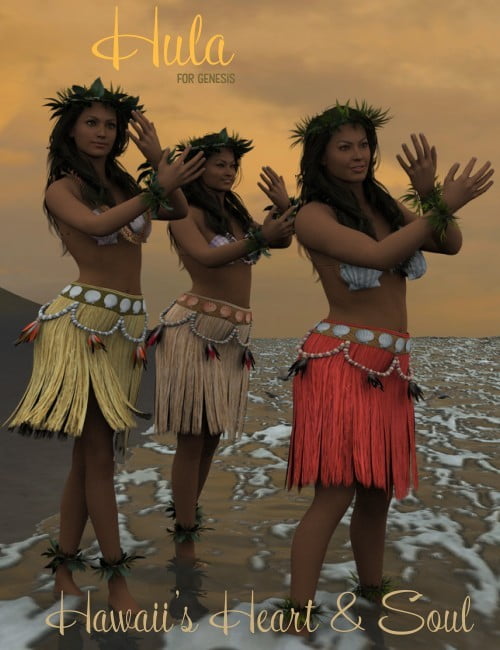
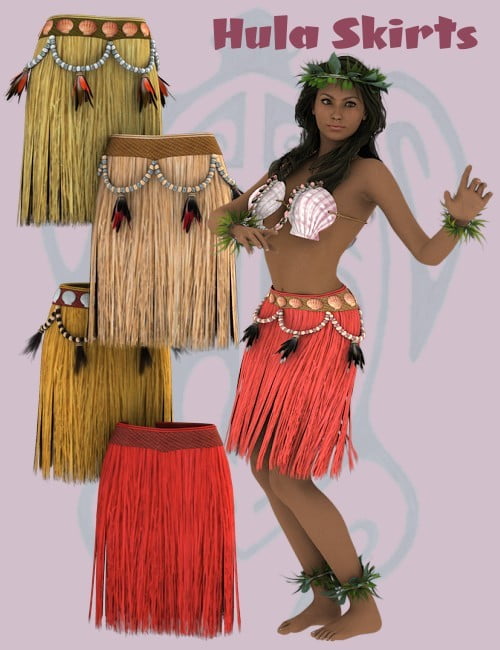
The 'Hula, Hawaii's Heart and Soul' set includes female traditional Polynesian clothing for the Genesis female shapes. Included in this set are a Hula Skirt and Shell Top, necklaces and leis and leaf/fern anklets, wrist and head bands.
Models: (.CR2and .DUF)
Hula Grass Skirt for female Genesis shapes
Shaping and Adjustment Morphs
Hula Seashell Top for female Genesis shapes
Shaping and Adjustment Morphs
Beaded Necklace for Genesis shapes
Shaping and Adjustment Morphs
Whale-tooth Necklace for Genesis shapes
Shaping and Adjustment Morphs
Flower Lei for Genesis shapes
Shaping and Adjustment Morphs
Leafy Ankle bands for Genesis shapes
Leafy Wristbands for Genesis shapes
Leafy Crown for Genesis shapes
Shaping and Adjustment Morphs
Hair Flower
Material Settings(.dsa)
Hula Grass Skirt
4 Preset Skirt designs
5 Grass skirt colors
4 Belt colors
6 Bead Colors
8 Tassel Colors
5 Seashell colors
Material controls to remove beading, belt and shells
Hula Seashell Top
3 Preset Top Designs
5 Seashell colors
Beaded Necklace
6 Bead Colors
Flower Lei
3 Flower colors
Leafy Wrist, Ankle and Head Bands
Fern or Mixed Leaf materials
Dark or Light Ties
Flower for Hair
5 Flower Colors